OBITUARIES
James Randal Ross, 80; O.C. judge wrote book on great-grandfather Jesse James
By Dennis McLellan
Times Staff Writer
March 9, 2007
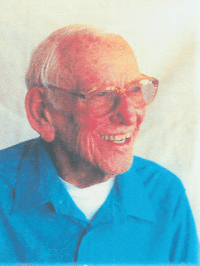
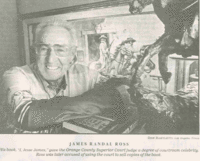
Retired Orange County Superior Court Judge James Randal Ross, the great-grandson of Western outlaw Jesse James who was once criticized for selling copies of a book he wrote about his notorious ancestor from his chambers, has died. He was 80.
Ross, a Fullerton resident, died of a heart attack Monday (Mar. 5, 2007) at St. Jude Medical Center in Fullerton, said his daughter, Liza Ross-Suwczinsky.
Ross was a long-time favorite alumnus of young and old, regaling with tales of his great-grandfather Jesse James and his days as a footballer on campus. Jim was a regular at Founders Day from the 1950s through the 1990s, and he helped to found Southern California chapters at Fullerton State and Long Beach State.
Ray Lahr recalls this story that has legendary status at Upsilon, when he returned to UCLA after his release from active Navy duty in 1946: “The first person I met was another Navy buddy, Dick Kater, who persuaded me to try out for the freshman football team. On my first day out, there was a knot of players standing in the center of the field. Jim Ross had laid a tackle on Dick Kater and broke Dick’s ankle. Now that led to a tough sell. Nevertheless, Jim Ross successfully recruited Dick and me into Sigma Pi. A year later my brother Verne returned from the service and joined us. How is that for turning a loss into a gain!”
Skip Keyzers recalls that Ross was Chapter Advisor and Province Archon during the 1950s: “Jim and his wife used to attend many of the house’s big parties to keep them from getting too wild. He was a very dedicated brother of Upsilon and all of Sigma Pi.”
Grand Sage Larry Rovira, a CSU Fullerton graduate who lived in Orange County near Ross, recalls that Ross played volleyball and waterskied into his 70s. Ross also attended Rovira’s wedding, and the two stayed in touch over the years. “He was a great brother and friend.”
Ross, who spent 29 years as an attorney in Los Angeles, served as a Superior Court judge from 1983 until his retirement in 1995.
During that time, he gained notice for his 1984 ruling that Disneyland had violated the civil rights of two gay teenagers when security guards removed them from the Anaheim amusement park for dancing together. In the next year, Disneyland ended its longtime policy prohibiting partners of the same sex from dancing together.
In 1997, Ross also made headlines when he was accused of four counts of misconduct during court proceedings that took place before his retirement. They included accusations that he dozed off on the bench on several occasions during two trials, told an off-color joke during a sexual abuse case with the victim present, used the court to sell copies of his book and humiliated and intimidated attorneys.
In a letter to Ross, the state Commission on Judicial Performance offered to drop three of the charges if Ross pleaded guilty to the one accusing him of exhibiting an angry demeanor to attorneys in a personal injury case.
But in his written reply, Ross refused to concede to any of the accusations.
“I will not back down,” he wrote. “As a direct descendant of Jesse James, no one in our family backs down.”
At the conclusion of the hearings, during which the 71-year-old Ross represented himself, a panel of three judges upheld all the allegations except for falling asleep during trial. In 1998, the panel censured Ross — who had continued to hear cases part time in retirement — prohibiting him from receiving assignments, appointments or references of work from any state court.
Ross was born July 6, 1926, in Independence, Mo., and moved with his family to Long Beach when he was 10 months old. He went to Wilson High School and graduated from UCLA in 1949 and from what is now Southwestern Law School in 1953.
Ross’ grandfather — Jesse James’ son, Jesse E. James — had accompanied the family to California, and as a boy Ross used to listen to his grandfather tell stories about the outlaw, who, along with his brother Frank, fought with Confederate guerrillas during the Civil War and then launched the string of robberies that made them famous.
Ross tapped those stories in writing “I, Jesse James,” his 1988 book published by Dragon Publishing Corp.
“He did a lot of research of facts, and then he filled in the facts with what his grandfather had told him, a lot of family history,” Ross’ daughter said.
In a 1995 interview with The Times, Ross said the experience of writing the book, which is narrated in the first-person voice of Jesse James, strengthened his bond with his family heritage.
“I don’t know what he actually said or thought, of course, but I feel I know so much about him that I can capture the way it might have been,” Ross said.
In writing the book, his daughter said, “he wanted the accurate story of Jesse James told, both the good and the bad, and let people decide for themselves.”
The book and Ross’ relationship to Jesse James gave the judge a degree of courtroom celebrity.
During the Commission on Judicial Performance hearings, Ross said he “never instigated or announced the book from the bench.” People, he said, had approached him to ask where they could buy the book and request his autograph. And to avoid disruptions, he said, he told the bailiff that he would have copies available in his office.
Ross-Suwczinsky said her father, who once appeared on a History Channel segment on his ancestor, had a collection of Jesse James memorabilia, including a gun and holster, a rifle, boots and other family heirlooms, which he donated to the Jesse James Farm & Museum in Kearney, Mo., about 15 years ago.
Besides his daughter, Ross is survived by his wife, Rosemary; another daughter, Bonnie Jo Barnes; two sons, Randal and David; and five grandchildren.
Services will be private.
*
dennis.mclellan@latimes.com